
Introduction:
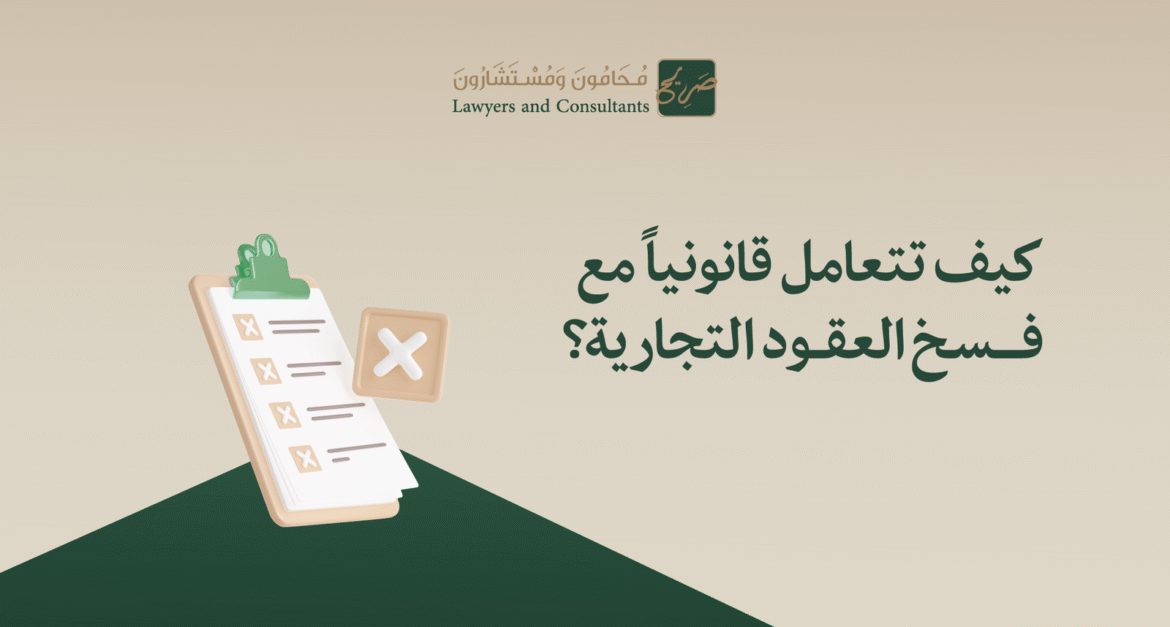
In the business world, commercial contracts are the backbone of any clear and binding commercial relationship. However, in some cases, one party may need to terminate the contract, whether due to a breach by the other party or changes in commercial circumstances.
This raises the important question: how can you legally handle termination without losing your rights?
What is Meant by Termination of a Commercial Contract?
Termination refers to the ending of the contractual relationship before the contract has been fully executed, either by mutual agreement of the parties or due to a fundamental breach by one party that justifies ending the contract.
Commercial termination in Saudi Arabia is governed by the provisions of the Civil Transactions Law and the General Civil and Sharia Law, in addition to the Commercial Court Law in the event of a dispute.
Situations Where Termination is Legally Permissible:
Under Saudi regulations, a party may request termination of a contract in the following cases:
- Material breach of any of the contract’s fundamental obligations.
- Delay in performance without a valid justification.
- Refusal by the other party to perform despite notice or warning.
- Existence of an explicit clause in the contract allowing termination upon the occurrence of a specific condition.
– Note: Not every breach justifies termination. It must be material and affect the purpose of the contract.
Practical Steps to Protect Your Rights When Terminating a Contract:
- Review the Contract Provisions:
Start by carefully reading the contract to verify if it includes a termination clause or specifies particular procedures, such as sending a written notice or providing a cure period for the breach.
- Send an Official Notice to the Other Party:
It is recommended to issue a written legal notice to the other party, explaining the reasons for termination and granting them an opportunity to remedy the breach if possible, to demonstrate good faith.
3. Document the Violations:
Collect evidence (documents, correspondences, reports) proving the breach or damage, as this evidence will be essential if the dispute is escalated to court.
- Avoid Unilateral Termination Without Contractual Basis:
If there is no clear termination clause in the contract, it is advisable to approach the Commercial Court to request judicial termination, especially in complex disputes or cases of mutual harm.
- Claim Compensation (If Necessary):
If termination results in material or moral damage, you have the right to claim compensation based on the extent of the harm and the degree of breach, as determined by the judge.
When is Termination Considered Unlawful?
If termination is carried out without legal justification or without following the procedures stipulated in the contract or law, the terminating party may be held liable for arbitrary termination and required to compensate the other party for damages.
The Importance of Legal Consultation Before Termination:
Termination decisions have significant legal and financial consequences. Therefore, it is always recommended to consult a lawyer specialized in commercial contracts before taking any action, to ensure your rights are protected and to avoid regulatory violations.
Conclusion:
Termination of commercial contracts is not always negative; it may be necessary to protect your interests. However, taking this step without proper legal knowledge may result in amplified losses.
If you want, I can also create a more concise, professional version suitable for a legal guide or business
افهم عقدك، وثّق خطواتك، واستعن بخبير قانوني قبل اتخاذ قرار الفسخ.